Did Megawatts Just Get More Expensive?
Digesting last week’s capitulation. AI demand didn’t change, supply did, and that picks the winners.
The outcome of last week cuts both ways. Good for some, terrible for others.
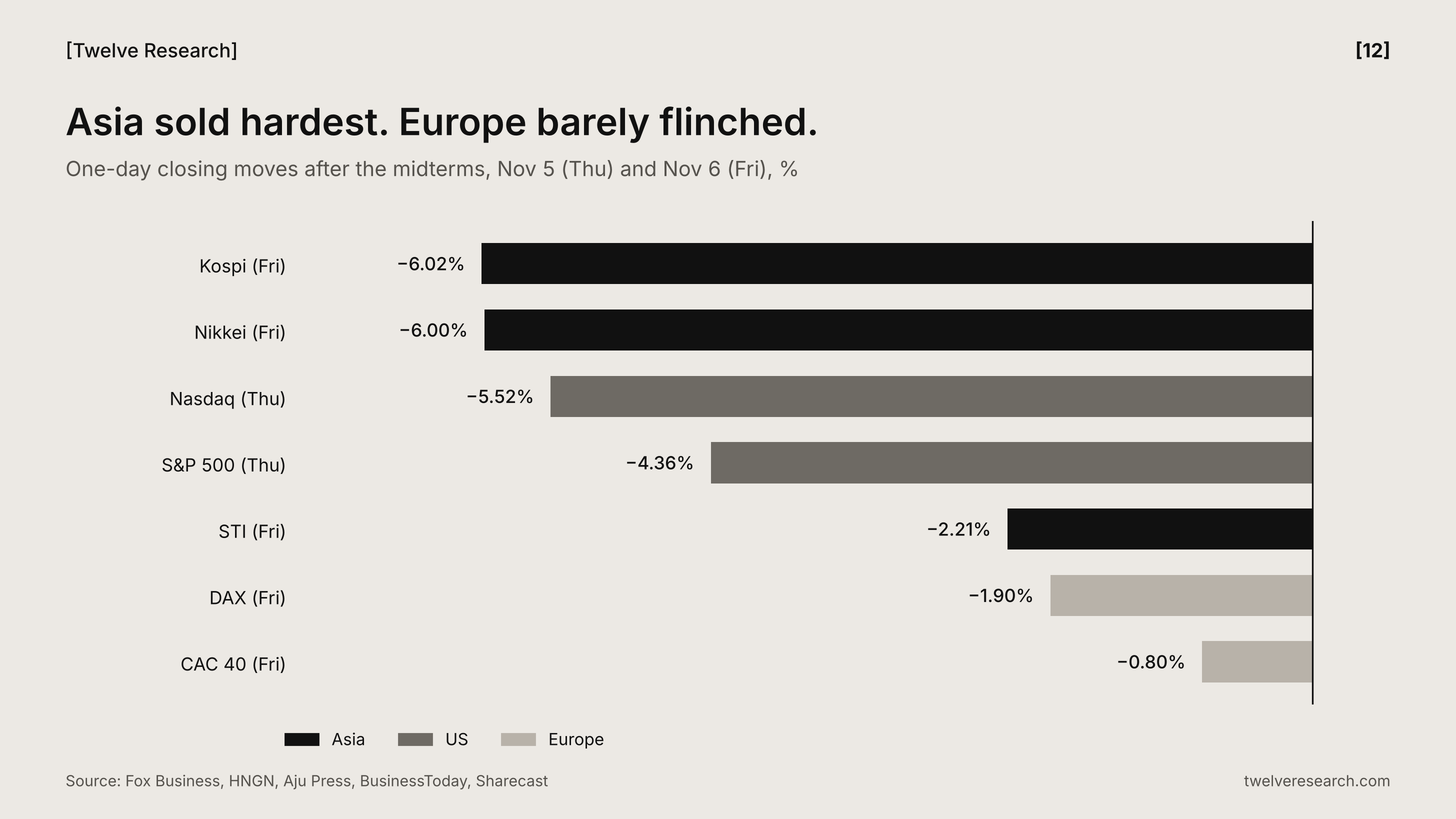
Markets, hedge funds, and banks spent last week struggling to decide whether Democrats killed the AI trade. On Thursday, we saw one of the biggest capitulation events since the Liberation Day tariff rout: the Nasdaq falling 5.52%, the S&P falling 4.36%, and the chip index falling more than 12%. The capitulation event reached Asia on Friday, with the Kospi plunging 8% intraday, triggering a 20-minute trading halt; the Nikkei fell 6%, and the STI slid 2.2%, whilst Europe barely flinched, with the DAX down 2% and the CAC 40 down less than 1%. The macro-sensitive asset, Bitcoin, fell 6.22% on Wednesday as well.
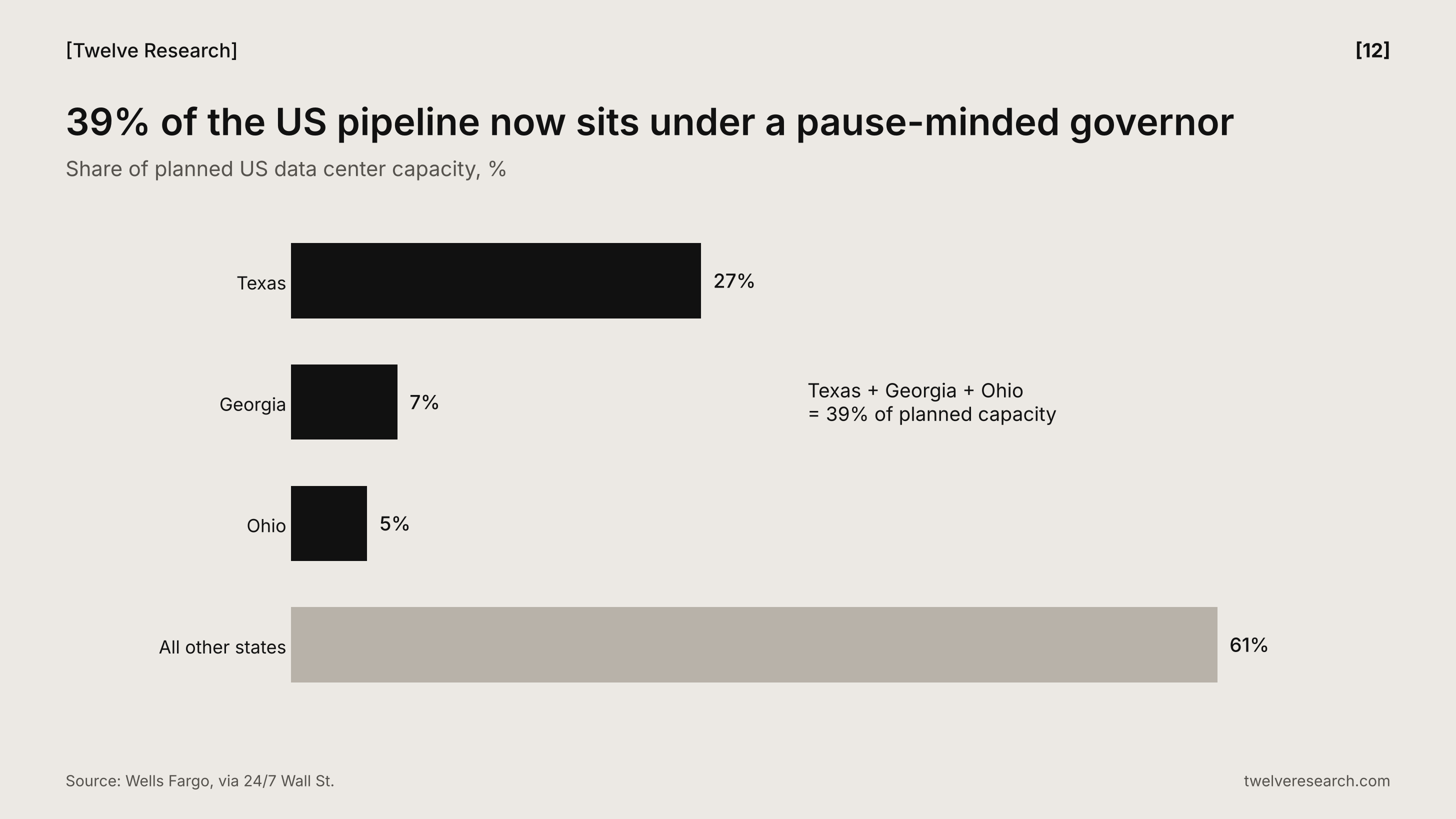
The event came as the Democratic wave swept across America. Primarily, Texas's fresh election of Gina Hinojosa, who heavily campaigned on a moratorium on new data center approvals until the legislature passes protections. Texas holds 27% of planned US data center capacity according to Wells Fargo. Her plan would keep approvals frozen at least until the legislative session opens in January, on top of the grid interconnection and permit pauses Abbott had already ordered. This was something our intelligence system at Twelve Research flagged out in September.
As an investor and trader, I cannot emphasize how paramount it is to remember to zoom out, separate signals from noise, and ask yourself: What fundamentally changed over the past 24 hours?
For months, the outcome of the Democratic Party winning was priced in. So what is it? What changed between today and yesterday? One of the likely factors was speculation that Democratic lawmakers were talking about an outright ban on Artificial Intelligence. Something that really just isn’t going to happen because that means falling behind in the Artificial Intelligence arms race against China.
As I take a step back, the capitulation event on Thursday tells me that it was primarily technical, with a sudden risk-off sentiment colliding with excessive levels of leverage. Combine the two, and you can see aggressive, potential forced liquidations within hedge funds and institutions. Tech-focused hedge funds lost over 4% that day, and Morgan Stanley recorded a 5% one-day drop in long-short net leverage, which is the fifth-largest since 2010. That is a textbook sign of a crowded trade unwinding.
With severe selling and capitulation going on, it’s easy to forget we are in the biggest technological revolution in human history.
The selling was technical, but the repricing underneath is real. Demand for compute didn’t change on Thursday. But the trajectory of power and permits did, and that’s what I’m going to get into.
Winners: The Megawatts That Already Exist
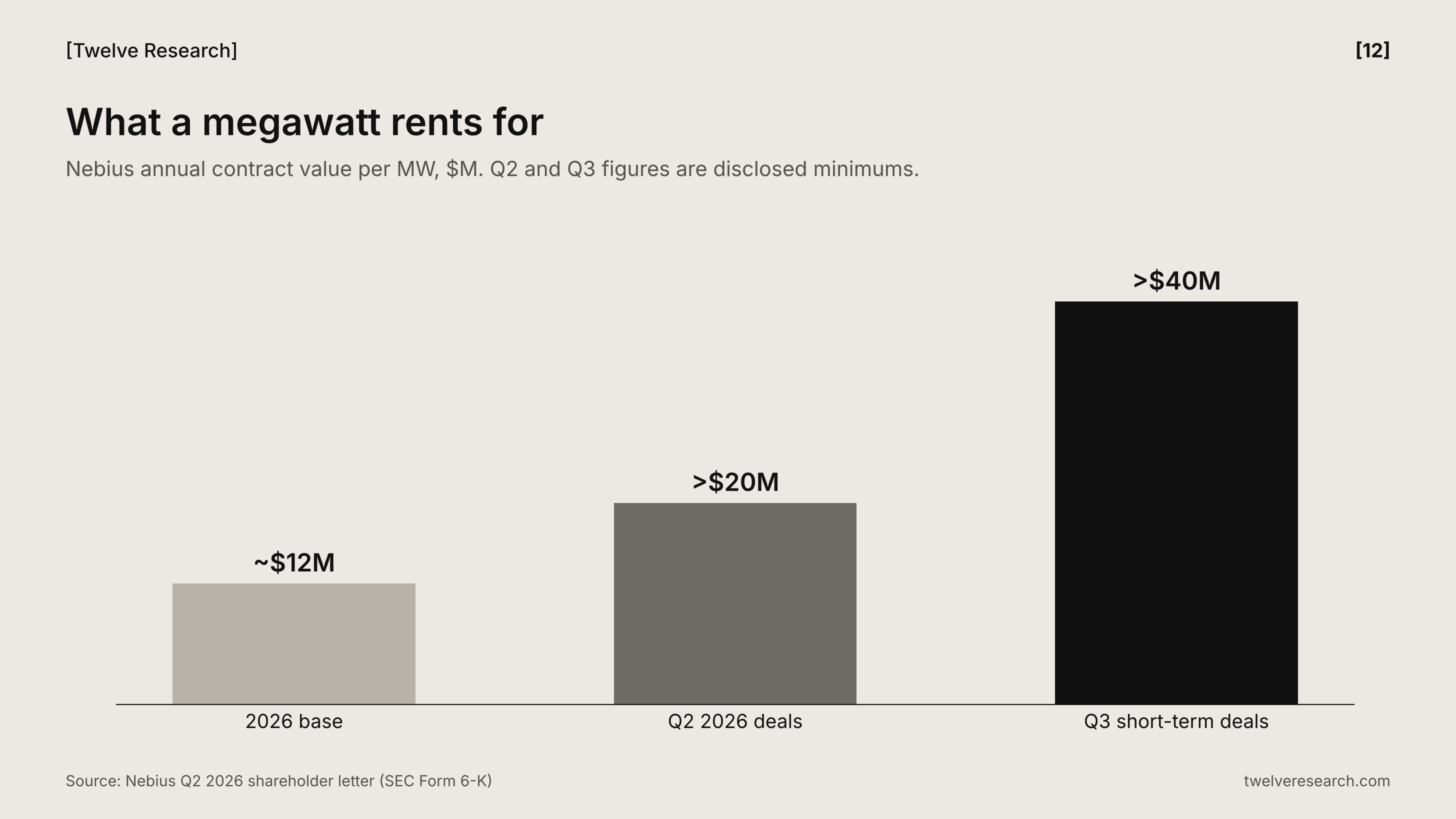
Simple economics here. Cut supply, hold demand constant, and the price for compute grinds higher. This was already happening prior to the vote, with Nebius’s annual contract value per MW going from $12M on its 2026 base to over $20M in Q2 deals and over $40M on short-term Q3 deals.
It’s worth noting that the freeze lands in 2028 and not 2027. That’s because roughly three-quarters of 2027 capacity is already underway, as per SemiAnalysis, so the damage hits the delivery window customers are contracting for right now. Anthropic's S-1 discloses that about 73% of its first-half compute spend sat outside cost of revenue, in training, research, and internal workloads that run as well in Finland as in Texas.
This makes energized, permitted, prepaid, and active capacity outside the paused states more valuable. Nebius has no disclosed Texas exposure, but last week showed the line is delivery-based, not geography-based. Microsoft is seen to be tightening its oversight with neoclouds on various projects, and Nebius’s Vineland, in New Jersey, was fined $1M for running generators without permits, with about 140 MW at risk of being delayed into 2027.
Losers: Megawatts on a PowerPoint
Texas, Georgia, and Ohio hold 39% of planned US pipeline, per Wells Fargo, and all three have elected governors who campaigned on slowing it. ERCOT is sitting on more than 400 GW of data center requests, including 6,608 MW that cleared every step except energization. Its audit lands on December 10, and regulators take it up on December 17.
Microsoft recently cancelled a $3B Nscale deal in the UK due to the fact that grid power was years away, and walked away from 1.35 GW letter of intent in West Virginia. That’s what happens to “promised” capacity. Debt-funded developers whose next megawatts need a new approval now carry interest without a clear delivery date.
The Pivot: Bring Your Own Power
Strip out the signal from the noise, and you’ll see the same thing. Politics and parties just want data centers to pay for their own power and to keep it off household bills. Fair. Abbott said in June that data centers must bring their own power, and Hinojosa wants to institute laws whereby Texans don’t have to pay for more energy. Ohio’s Amy Acton wants developers to cover all of their utility costs. Even CoreWeave’s policy chief says families shouldn’t pay for new lines and plants. The only way around that is behind-the-meter generation.
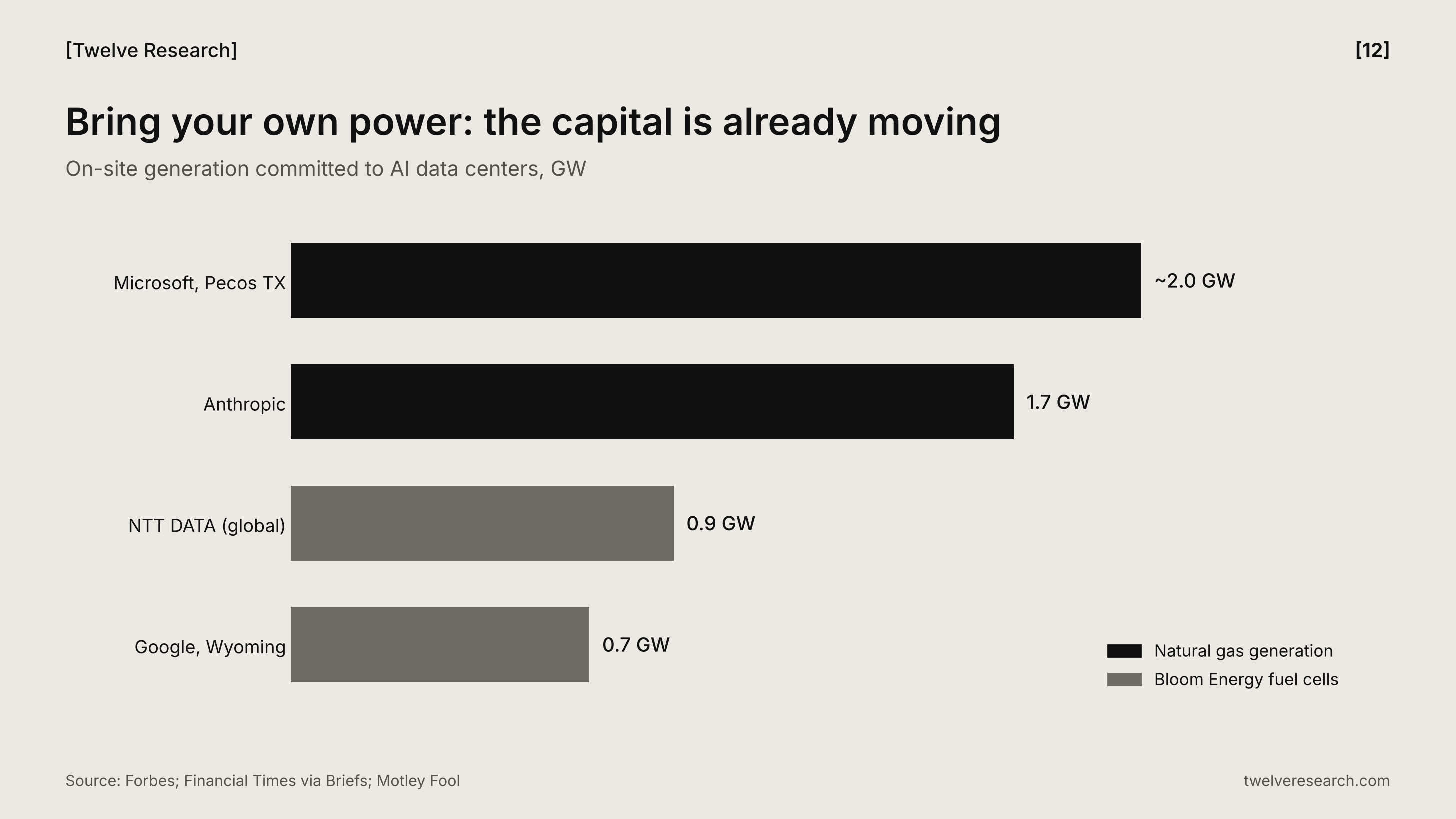
The capital is already flowing that way, with Anthropic agreeing to pay $3.4B for 1.7 GW of gas generators. Microsoft is building about 2 GW in Pecos, Texas, with on-site gas. And on Thursday, the Nasdaq had its worst day in 19 months. Bloom Energy announced 1.6 GW of fuel cell orders: 900 MWs for NTT DATA and 702 MWs for Alphabet’s $17B Wyoming Campus.
The catch, however, is that in Texas, bring-your-own-energy is more of an exit and less of a bypass. On-site generation still requires TCEQ (Texas Commission on Environmental Quality) air permits, and Hinojosa’s moratorium covers approvals regardless of power source. Once the legislature solidifies its rules, “prove you won’t raise household bills” becomes a test, and self-supplied power becomes the easiest way to pass it.
Martin
Twelve Research
https://twelveresearch.com
martin@twelveresearch.com
Disclaimer: This article is published by Twelve Research Pte. Ltd. for informational and educational purposes only. It is not financial, investment, legal or tax advice, and it is not a recommendation or solicitation to buy, sell or hold any security. The views expressed are the author’s own as of the date of publication and may change without notice. Data is drawn from sources believed to be reliable, but its accuracy and completeness are not guaranteed. Investing involves risk, including the loss of principal, and past performance does not predict future results. Always do your own research, and consult a licensed financial adviser before making any investment decision.